

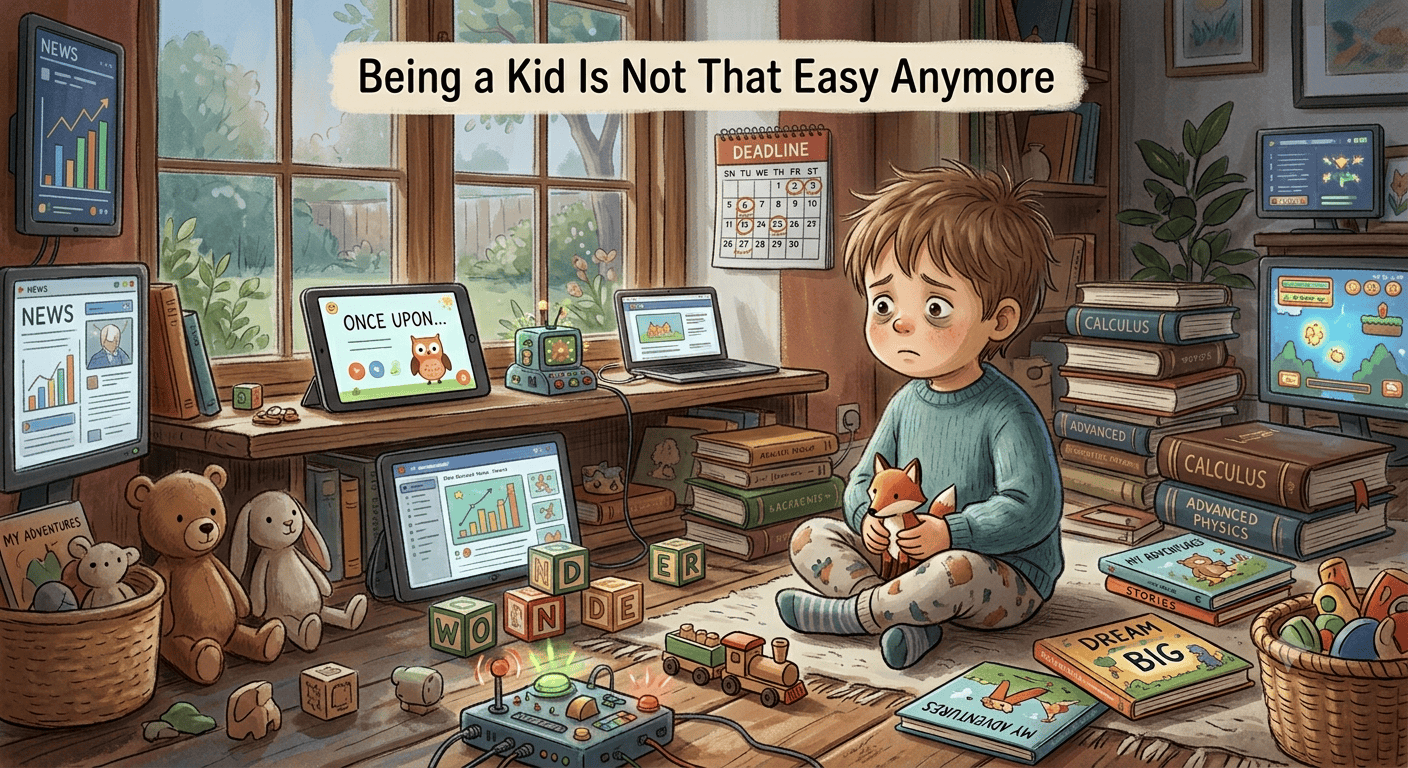
Sometimes, I look at children under ten and wonder: is childhood really as fun, innocent, and carefree as we remember it?
When we look back at our own childhoods, we remember long afternoons spent playing outside, simple games, and a world that felt manageable. We had our share of problems, too, but our horizons were smaller. We didn’t know every piece of news, every adult problem, or every trend happening around us—and that limited exposure was a quiet blessing. It gave us space to grow up at a natural, gentle pace.
Today, however, growing up looks completely different. Behind the colorful toys, digital gadgets, and comfortable lifestyles, children today are fighting quiet battles we never had to fight at their age. They live in a hyper-connected, fast-moving, and overwhelming world where information flows relentlessly from screens, school buses, older peers, and social media.
They are forced to process adult concepts, rigid social expectations, safety warnings, and subtle biases long before their young minds have the emotional maturity to make sense of them. They may appear smarter, sharper, and more aware than we ever were at ten—but beneath that polished surface lies a silent, daily struggle to navigate a world that expects them to grow up far too fast.
When we look closely at their daily lives, this struggle shows up in very specific ways:
1. They see, hear, and copy things before they are ready
Children learn by watching, and they copy behaviors long before they understand the meaning or consequences behind them.
My own son once came home from school and told me that kids on his bus were showing each other the middle finger. He knew it was a bad gesture used to insult or irritate someone, but he had no idea what it actually meant. It made me realize how quickly children pick up ways to provoke others or get a reaction. They pick up bad words, mean gestures, and violent behavior from YouTube shorts, video games, movies, and older kids at the playground.
When a child repeats a swear word or a bad gesture, our first instinct as parents is often to shout or scold them. But scolding alone doesn’t teach them anything. Most of the time, the child doesn’t even know why the action is hurtful—they only know it gets attention or makes them look “cool.” Instead of angrily asking, “Who taught you this?” we need to calmly explain why the behavior is wrong, helping them learn without making them afraid to talk to us.
2. They learn about danger before they even understand the world
In today’s world, we have to teach young children about personal safety—good touch and bad touch, stranger safety, and keeping boundaries. Every child needs to know that their body belongs to them and that they should tell a trusted adult if someone makes them feel uncomfortable.
However, these serious talks can also make kids feel scared or confused. A simple warning about strangers might make a child afraid to speak to a friendly neighbor or shopkeeper. On top of that, children deal with real-world stress like being left out at recess, teased on the bus, or seeing disturbing news clips.
We can’t stop teaching them about safety, but we have to be gentle. The goal is to teach them how to be cautious without making them feel like the world is a terrifying place.
3. They compare their lives with everyone else
When we were young, we only compared ourselves to our classmates, cousins, or neighbors. Today, even an eight-year-old sees flashy video games, luxury toy unboxing videos, and styled kids on screens.
They quickly start noticing who has the latest gadget, who wears branded shoes, or who lives in a bigger house. A child who was perfectly happy playing with a simple toy suddenly feels left out after watching someone else’s expensive lifestyle online.
They are too young to realize that what they see on screens is edited or exaggerated, but they are old enough to feel, “My life isn’t good enough.”
4. They pick up stereotypes and half-truths from the outside world
Even when we raise our children at home with open minds, the outside world quickly starts filling their heads with rigid rules. Kids listen to older seniors on the school bus, watch quick videos online, and copy what they hear at recess. They pick up heavy ideas, biases, and labels before they are old enough to understand what they really mean.
My son is a perfect example of this. When he was younger, he loved playing with a toy kitchen set I bought him and spent hours happily cooking up imaginary meals. But after hearing older kids at school, he came home one day and insisted, “Kitchen sets are only for girls!” Suddenly, he was telling me that pink is a girl’s color, certain jobs are only for women, and even made comments about people’s looks or religious backgrounds being “not good”—ideas we have never taught or spoken about at home.
Children pick up these stereotypes so easily because their young brains like simple categories. The real problem is that these half-baked ideas can turn into prejudice or secret insecurity if we don’t catch them early. They need us to calmly listen, ask them “Why do you think that?”, and gently untangle those thoughts without getting angry.
5. They have less freedom to just explore and be kids
Remember when we could just run outside, gather a few neighbourhood kids, invent a silly game with a stick and a ball, argue over the rules, make up, and play until dusk?
Today, that kind of free, open play has almost disappeared. Between heavy school bags, homework, tuition, activity classes, and screen time, children rarely get time to just sit quietly and figure out how to play on their own. And when they do get a moment of downtime, we as parents are often so quick to hand them a tablet, turn on the TV, or buy them a new toy to keep them occupied. Because we constantly fill every quiet gap for them, children today simply haven’t learned how to handle being bored on their own.
When you put four or five kids together today, many don’t even know what to do unless an adult sets up a structured activity with pre-made rules. They miss out on the freedom to invent their own games, negotiate rules, settle small playground fights, and figure things out naturally. Boredom isn’t actually a bad thing—if we stop trying to fix it immediately with screens and gadgets, it gives children the space to use their imagination and just enjoy being kids.
6. Parents are exhausted, and kids feel it
Modern parents are constantly stretched thin. Balancing demanding jobs, house chores, bills, and daily stress takes a toll. Parents love their children deeply, but at the end of a long day, there is often very little energy left.
A child might wait all day to tell their parent a story about what happened during lunch break, only to be told, “Not now, I’m tired,” or “Go watch TV for a bit.” Conversations get rushed, bedtime stories get skipped, and patience runs out quickly.
This isn’t about blaming parents—everyone is trying their best. But children notice when we aren’t truly listening. Often, a child doesn’t need a new toy or an expensive weekend trip; they just need ten minutes of our complete, undivided attention.
7. We expect them to act like adults before they even know how
We want our children to be polite, confident, well-behaved, and calm. But we forget that a nine-year-old’s brain is still developing. Managing big feelings like jealousy, anger, or disappointment is very hard for them.
A child might know that screaming is wrong, but when their younger sibling breaks their favorite toy, they might still lose their temper and shout. Knowing what is right and being able to control your emotions during a meltdown are two very different things.
Kids need rules and consequences, but more than that, they need our patience while they learn how to handle their emotions.
How Can We Help Them?
We cannot change the fast-paced world we live in, but we can make home a safe, gentle place for our kids:
- Explain, don’t just scold: When our child repeats a bad word or gesture, our first reaction is often shock or embarrassment that our child could say such a thing—and we end up reacting too strictly out of instinct. Instead of yelling or shaming them, take a deep breath and explain why it’s wrong and hurtful.
- Make safety talks gentle: It’s vital to teach kids about good touch, bad touch, and personal boundaries, but the tone matters deeply. If we talk about safety with fear in our voice, children can start viewing every stranger, neighbor, or shopkeeper as a threat. Teach them the rules of safety calmly, like you would teach them to wear a helmet, so they feel protected rather than paranoid.
- Stop comparing: It’s natural to want our kids to excel, but comparing their marks, clothes, toys, or confidence to other children secretly chips away at their self-worth. When children feel they are constantly being measured, they stop playing for fun and start acting to seek approval. Let them know their value at home isn’t tied to a report card or owning the latest gadget.
- Let them figure out boredom: When a child says, “I’m bored,” our quick instinct is to solve it by handing over a phone, turning on the TV, or buying a new toy. But constant entertainment stops them from learning how to entertain themselves. When we resist the urge to immediately plug that gap with a screen, we give their brains the quiet space needed to daydream, make up silly games, and tap into real creativity.
- Unpack stereotypes together: Children absorb rigid social rules from school buses, playground chat, and older peers. When they repeat things like “pink is for girls” or make comments about someone’s religion or physical appearance, don’t just shut them down or get angry. Ask them with curiosity, “Where did you hear that?” or “Why do you think so?” This opens a comfortable doorway to gently untangle those ideas and show them a broader, kinder view of the world.
- Just listen: Children wait all day to tell us about tiny, seemingly trivial things—what someone said at lunch, a game played at recess, or a silly joke. When they talk, try to give them 10 to 15 minutes of undivided attention without jumping in to give advice, point out mistakes, or lecture them. Simply feeling heard makes them feel valued, safe, and far more likely to come to you when big problems arise later.
- Remember their real age: Today’s kids often pick up adult vocabulary, repeat clever lines from videos, and act remarkably smart. It’s easy to forget that beneath those big words and mature attitudes, they are still under ten years old. Their emotional brain—the part that manages frustration, anger, jealousy, and disappointment—is still under construction. Don’t expect adult emotional control from a mind that is still growing
Disclaimer: Unauthorized use, duplication, or reproduction of this material without express and written permission from this site’s author and owner is strictly prohibited.