

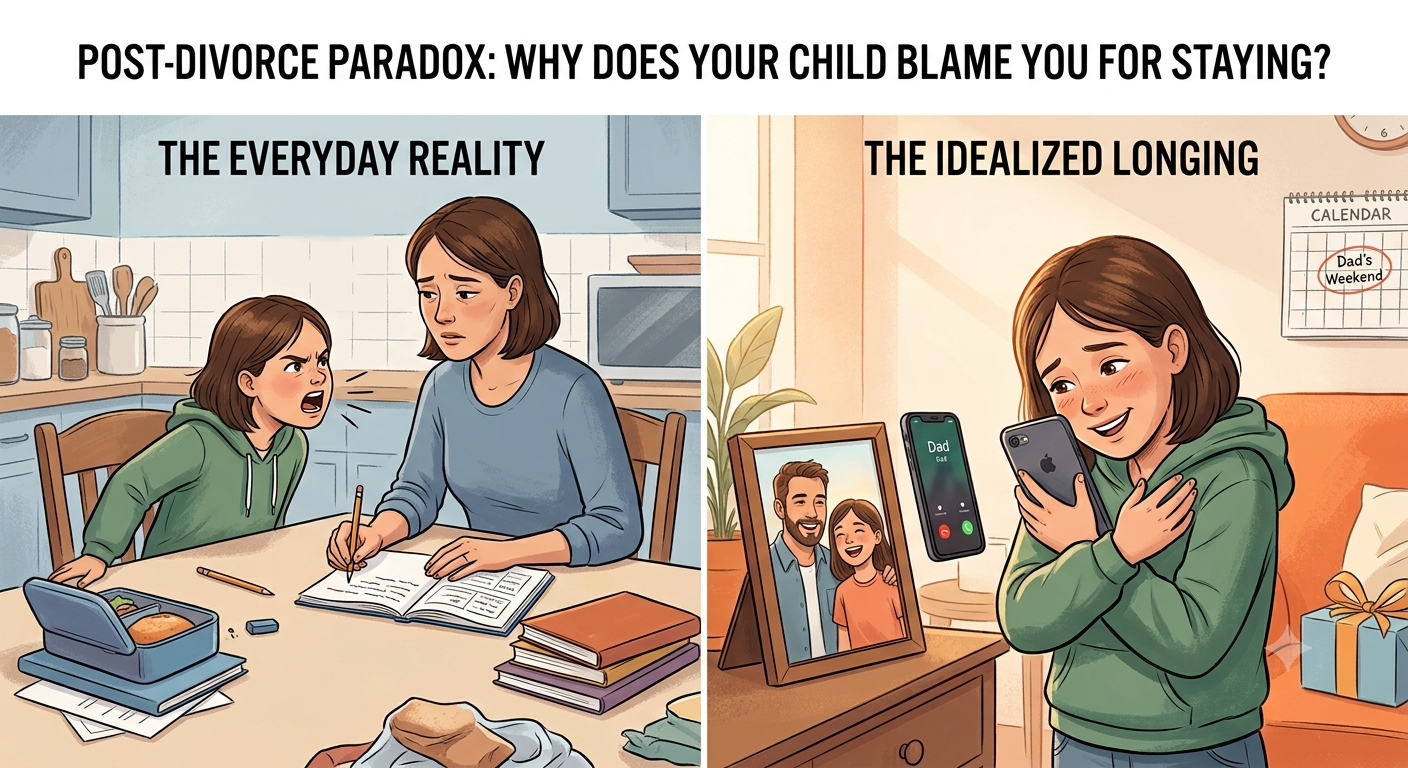
Understanding the complicated emotions of children after divorce
Divorce is painful enough when you are trying to come to terms with the end of your marriage, the loss of the life you imagined, and a future that suddenly looks nothing like you planned. You are trying to hold yourself together, adjust to a new reality, and somehow make life feel stable for your children when nothing feels normal anymore.
And then, there is another kind of pain you may not have been prepared for: the anger of your own children.
You are the one who wakes them up for school, makes sure they eat, helps with homework, and worries about their future. You swallow your own tears because you do not want them to see how much you are hurting. Yet, somehow, you become the person they blame.
They snap at you. They accuse you of ruining their family. They tell you they hate you. Meanwhile, the parent they miss—the one they wait for, talk about, and wish would come home—is the very person whose absence you are struggling to help them understand.
Perhaps you have watched your child light up at the mention of the other parent’s name while barely acknowledging everything you do. Perhaps you have heard them say they want to live with the parent who left. And through tears you hide from everyone else, you may have wondered:
“Why am I the one bearing their anger when I am already hurting? Why do they treat the person who stayed like the enemy, while longing for the person who left?”
If you have ever felt this way, your pain deserves to be acknowledged. But your child’s behavior does not mean they love you any less. Here is what is truly happening beneath the surface—and how you can navigate it.
At a Glance: Understanding the Emotional Shift
| What You Experience | What Your Child Is Actually Processing |
| Unappreciated for doing daily chores and managing rules | They associate home with routines and restrictions, and the absent parent with fun and special events. |
| Hurt by their angry outbursts and hurtful words | They are testing their safest target, trusting that your love is unconditional and you won’t leave. |
| Rejected when they miss or ask about your ex | They are grieving the fantasy of a whole family, not rejecting your presence. |
| Exhausted by constantly being blamed | They find it easier to confront the parent who is there than risk losing the parent who left. |
1. The Parent Who Stays Becomes the Face of Daily Reality
When a family separates, one parent usually carries the weight of the daily routine. Morning rushes, homework battles, bedtime rules, and household chores continue—even while that parent is grieving a broken marriage. Life does not stop simply because your relationship ended.
The parent who lives elsewhere, however, often sees the child during weekends, holidays, or scheduled visits. These visits naturally center on relaxed time, fun activities, and undivided attention, with far fewer arguments about chores or screen time.
Over time, a child’s brain makes a natural, automatic association:
- The parent at home = Rules, responsibilities, and restrictions.
- The absent parent = Fun, freedom, and special moments.
This does not mean the other parent is trying to buy affection, nor does it mean you are doing anything wrong. It simply means children experience relationships through their immediate environment. The parent who handles ordinary life becomes the target for ordinary frustrations.
2. Children Vent Where They Feel Safest
Children rarely have the emotional tools to say: “I miss my old life,” “I’m scared of what comes next,” or “I’m terrified that you might leave me too.” Instead, their confusion, grief, and fear show up as hostility, rebellion, or tears.
Paradoxically, children vent their hardest emotions at the parent they trust the most.
Deep down, your child knows your love is unconditional. They know that no matter how loudly they yell or how hurtful they act, you will still wake them up tomorrow, feed them, and protect them. They push you because they know you won’t leave.
When your child says, “I hate you,” they are rarely rejecting you. They are expressing a pain they do not yet know how to put into words, directed at the person who feels safe enough to hold it.
3. The Absent Parent Becomes an Idealized Fantasy
When a parent is no longer around every day, a child’s imagination naturally fills in the blanks. They hold onto memories of happier times and build a fairytale version of what life would be like if that parent came home.
They might tell themselves:
- “If Dad were here, everything would be happy again.”
- “If Mum lived with us, she wouldn’t make me do homework.”
Your child is not comparing you to their actual ex-partner. They are comparing the messy, imperfect reality of daily life against an imagined, perfect family. Real life will lose that comparison every single time, but holding onto that fantasy gives the child a sense of hope when everything else feels out of control.
4. The Parent Who Stays Is the Easier Person to Blame
Divorce leaves children with big, scary questions: Why did this happen? Could I have stopped it? Was it my fault?
To protect themselves from the overwhelming fear that they caused the breakup, children look for an answer that makes sense to them. Blaming a parent feels safer than accepting that their whole world was upended by adult decisions they couldn’t control.
Because you are there every day, you are accessible. Your child can question you, confront you, and demand answers from you. Confronting an absent parent feels far more dangerous—the child often fears that being angry with them might push them away completely.
5. They Are Caught in a Loyalty Conflict
One of the most exhausting experiences for a child after divorce is feeling that loving one parent means betraying the other.
If a child comes home excited from a visit and notices you becoming quiet or tearful, they may feel intense guilt for having fun. Similarly, if they hear one parent criticize the other, they feel immense pressure to pick a side.
When children feel torn in half by loyalty conflicts, that internal stress frequently spills out as anger at home. A child should never feel they have to prove their love for one parent by rejecting the other.
Practical Guide: How to Handle the Tough Moments
Understanding the psychology helps, but managing the day-to-day outbursts requires real-world tools. Here is how you can navigate the emotional minefield, support your child, and protect your own peace.
1. Allow Them to Miss the Other Parent
Never treat their longing as a personal rejection. Validating their feelings teaches them that loving their other parent doesn’t threaten their relationship with you.
When your child says: “I wish Dad were here.”
What you can say: “I know you miss him, sweetie. It’s completely okay to miss your dad, and it’s tough when you can’t see him whenever you want.”
2. De-escalate Outbursts: Listen Before Defending Yourself
When your child lashes out with wild accusations (“You ruined our family!” or “You’re horrible!”), resist the urge to correct the facts or explain your side of the divorce. Address the raw emotion beneath the words first.
When your child says: “You ruined our family!”
What you can say: “I hear how angry and hurt you are about how much everything has changed. I’m right here whenever you’re ready to talk about what hurts the most.”
3. Set Firm, Loving Boundaries
Validating emotions does not mean accepting cruelty, verbal abuse, or physical aggression. You can offer a safe harbor for their grief while keeping high standards for how you are treated.
- Separate the emotion from the behavior: Acknowledge that the feeling is okay, but the delivery needs work.
- Pause the argument: Avoid power struggles when tempers are high. Offer a cool-down period before addressing respect.
What you can say: “It is 100% okay for you to feel angry with me about the rules, but it is not okay to call me names. Let’s take ten minutes to cool off, and then we’ll figure this out together.”
4. Create Safe Outlets for Expressing Anger
Children often don’t know where to put their heavy emotions. Give them physical and constructive ways to discharge bottled-up frustration:
- Journaling or Drawing: Ask them to write a “mad letter” or draw how their heart feels (reassure them no one else has to read it).
- Physical Release: Encourage them to throw a ball against a wall, punch a pillow, go for a run, or tear up old paper when they feel like exploding.
- Name the Emotion: Help young kids build emotional vocabulary using simple scales (“Are you feeling a little annoyed, or is this a full 10/10 explosion?”).
5. Keep Routines Predictable to Build Security
When a child’s family breaks apart, their world feels unpredictable. They test boundaries at home to see if their remaining foundation is solid.
- Don’t drop discipline: Do not stop enforcing bedtime or chores out of guilt. Structure tells a child, “I am calm, in control, and keeping you safe.”
- Maintain visual schedules: Use calendars or routine charts so they always know what’s coming next (e.g., school days, visit days, dinner times).
- Avoid overcompensating: Resist buying extra toys or giving in to demands to compete with the other parent. Children thrive on consistent boundaries, not endless gifts.
6. Protect Them from Adult Conflicts
To prevent loyalty struggles and reduce your child’s anxiety:
- Never use your child as a messenger or ask them to report back on what happens at the other parent’s house.
- Keep adult venting private. Process your own grief, anger, or legal frustrations with friends, family, or a therapist—never with your child.
- Support their relationship: Even if you dislike your ex, encourage your child to enjoy their time away without guilt.
7. Protect Your Own Emotional Well-Being
You cannot pour from an empty cup. Carrying your own heartbreak, your child’s anger, and all the responsibilities of daily life is exhausting.
- Build an adult support team: Surround yourself with people who listen to and validate your pain so you don’t look to your child for comfort or validation.
- Take mini-breaks: Give yourself 10 minutes of quiet time after school/work before diving into the evening routine.
- Give yourself grace: You will lose your patience sometimes. When you do, simply apologize, repair, and keep going (“I was overwhelmed earlier and snapped at you. I’m sorry, and I love you”).
A Final Thought: A Child’s Love Isn’t Always Expressed Where We Expect It
Perhaps the most painful part of being the parent who stays is that your sacrifices often go unseen for a very long time. You carry the weight, enforce the rules, dry the tears, and absorb the anger—while the parent who left receives the longing.
But keep showing up.
Your child’s anger is not proof that you are failing. In many ways, it is proof that you have built a foundation so secure that your child feels safe enough to fall apart in your arms.
Divorce changes the structure of a family, but it does not change a child’s fundamental need to feel loved, safe, and secure. One day, the fantasy will fade, and your child will look back and recognize the quiet, steady strength of the parent who stayed.