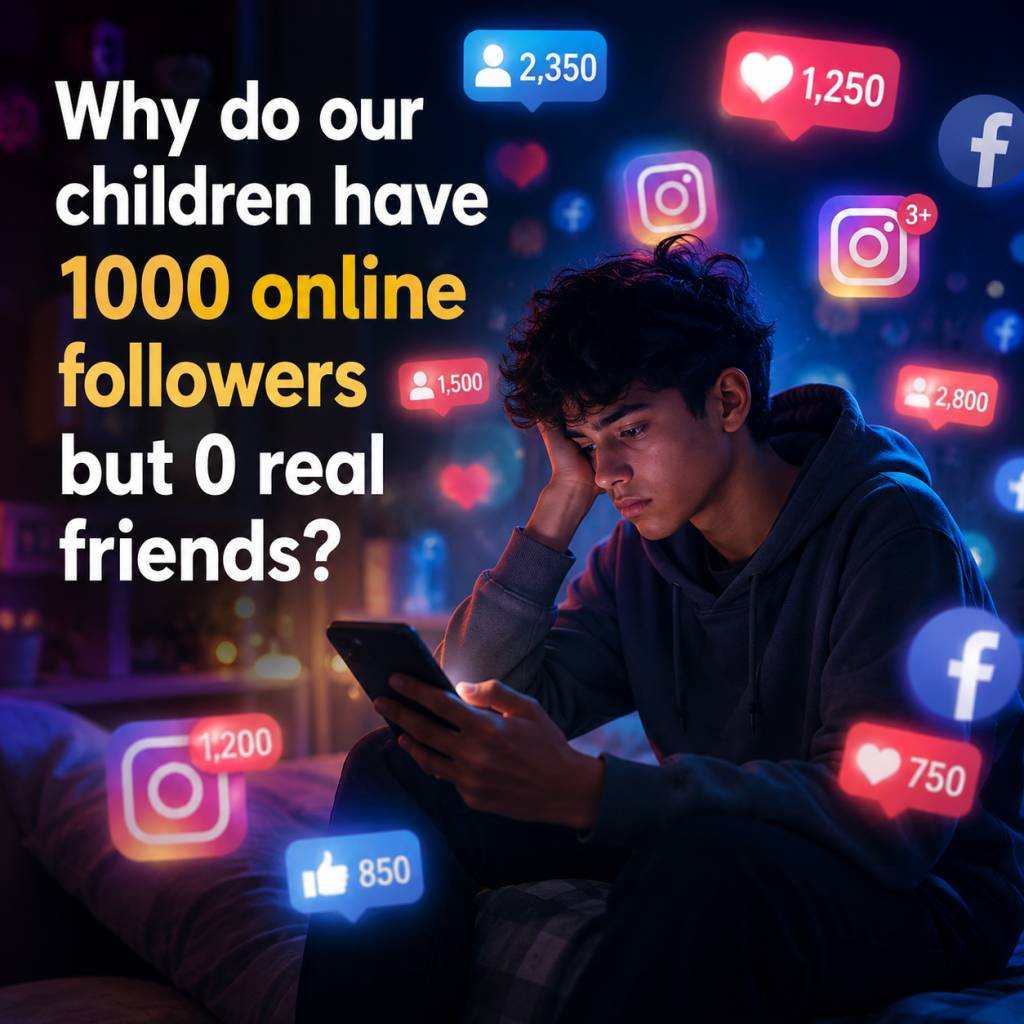
Why the Digital World Has Left Our Children with 1,000 Online Followers but 0 Real Friends

Why the Digital World Has Left Our Children with 1,000 Online Followers but 0 Real Friends

When parents look at their children today, it is easy to assume they are the most connected generation in human history. They are constantly on their phones, they have hundreds of Instagram or Facebook friends, snap streaks, and active WhatsApp groups. They are almost never technically “alone.”

But during my time volunteering on a mental health crisis helpline, I noticed a heartbreaking pattern.

When struggling children were asked:

“Do you have a close friend or someone your age you can talk to about what you’re feeling?”

The answer was often:

“No.”

And that answer made me think.

How can a child have hundreds of contacts, conversations and followers—and still have absolutely no one to call when they are falling apart?

Because being connected is not the same as being known.

And having people around you is not the same as having someone who will sit beside you when you are hurting.

1. Classmates and Followers, Not Real Friends:

There is a massive difference between having an online audience and having a genuine friend. Today’s kids have plenty of classmates, social media followers, and gaming buddies. They can share a meme, send a reel, maintain a streak or react to someone’s story within seconds.

But they cannot share their vulnerability. But friendship requires something much deeper. It requires being able to admit that they are not flawless, that they can also be weak and sad.

A friendship that exists mainly through likes, reactions and casual conversations may not have the emotional depth required to hold someone through a crisis.

A child may have 500 people they can message.

But when they are crying at 2 a.m., they may not know a single person they can actually call.

That is the difference between social connection and emotional connection.

2. The Fear of Digital Judgment

The digital world has also made children incredibly visible.

They see everyone else’s best moments—the holidays, birthdays, achievements, beautiful photographs, celebrations and seemingly perfect lives.

And slowly, they learn to present themselves in the same way.

Happy.

Confident.

Popular.

Fine.

But what happens when a child doesn’t feel fine?

Who do they tell?

Vulnerability becomes frightening when you don’t trust the person on the other side of the screen.

A private confession can become a screenshot.

A mistake can become a joke.

A photograph can be shared.

A personal conversation can travel through an entire school within minutes.

So children learn something dangerous:

It is safer to look okay than to admit that you aren’t.

And when everyone is trying to appear perfect, genuine emotional connection becomes much harder.

3. The Loss of Real-World Connection Skills

Deep, resilient friendships aren’t built through text messages; they are built through playing together, having awkward conversations, learning to resolve conflicts face-to-face.

These seemingly ordinary experiences teach children something screens cannot fully replace: how to be emotionally present with another human being.Because children spend their formative years communicating through filters, emojis, and screens, many have become deeply anxious about real, face-to-face conversations. They don’t know how to build the slow, foundational trust that a true friendship requires. They are left digitally connected, but emotionally malnourished.

The Question Parents Should Really Be Asking

Instead of asking, “How many friends do you have?”

We should ask, who would you call if you were really upset? Who can you cry in front of?” ” Who can you sit with when you don’t feel like talking?

Because a child doesn’t need 1,000 friends.

They need one safe person.

The goal isn’t to take children away from the digital world, but to make sure it isn’t the only place where they know how to connect.

Encourage real friendships, face-to-face time, play and shared experiences. Teach them that friendship isn’t measured by likes or replies.

It’s about who stays when there is nothing worth posting.

Because a child can be surrounded by people and still feel completely alone.

Sometimes, the loneliest child is the one whose phone never stops buzzing.

If you want to understand how these deep, hidden loneliness leaves children entirely unable to handle daily academic and social pressures, read our companion guide: Why “Minor” Issues Trigger Severe Breakdown in Kids: The Warning Sign Parents Miss – Keep Smiling]

Why “Minor” Issues Trigger Severe Breakdown in Kids: The Warning Sign Parents Miss

Why “Minor” Issues Trigger Severe Breakdown in Kids: The Warning Sign Parents Miss

As a volunteer on a mental health crisis helpline, I have sat on the other end of the phone with children who were completely broken down. Some were even experiencing severe panic or feeling suicidal.

When you look at the surface trigger, it often looks shockingly small to an adult: a dropped mark on a school test, a minor disagreement with a teacher, or a strict scolding from a parent. It is incredibly easy for an adult to look at this and think, “Why is this generation so fragile? Why can’t they handle small, everyday pressures?”

But after speaking directly to dozens of these children, I learned a terrifying truth that every parent needs to understand. It is never about the small issue. It is about the absolute isolation.

When we asked these struggling children a simple, gentle question—”Do you have a close friend or someone your age you can discuss this with?”—the answer was almost always a quiet, devastating, “No.”

Trapped in the Middle: Why Kids Stop Talking

When a child is overwhelmed by life, they naturally need an emotional release valve. Historically, if they couldn’t talk to their parents, they would turn to their peers. But a massive number of modern kids today find themselves trapped in a silent, dangerous dead zone:

Why they don’t tell their parents: When we asked kids why they didn’t talk to their mothers or fathers, their answers broke my heart. They said, “They just won’t get it.” They fear judgment, they fear being lectured, or they deeply fear disappointing the people they love most.

Why they don’t tell their friends: They feel they don’t have them. While today’s kids are surrounded by digital notifications, classmates, and virtual acquaintances, they are profoundly lonely. In fact, our modern, hyper-connected world has fundamentally broken how our children build deep, trustworthy connections.

Without a single human being to validate their feelings, a minor problem transforms into an absolute monster. A low-test score isn’t just a bad grade anymore; in an isolated child’s mind, it becomes an inescapable proof that they are a total failure and completely alone in the world. The cup was already filled to the very brim with silent loneliness—the minor issue was just the final drop that caused it to overflow.

3 Warning Signs Your Child Is Drifting Into Isolation:

The “Fine” Shield: When asked about their school day or emotions, they always give a flat, automated, one-word answer (“Fine”, “Okay”) and immediately retreat to their bedroom, laptop, or phone screen.

Over-proportional Explosions: A minor setback (like losing a casual game, a broken pen, or a simple chore request) triggers a massive emotional meltdown, intense crying, or sudden rage. This means their emotional cup is already full.

The Absolute Lack of Peer Stories: They rarely mention classmates by name with affection, never ask to host or visit a friend, and spend their free time entirely isolated from children their own age.

How Parents Can Break the Silence

If you want your child to survive the massive emotional and academic pressures of the modern world, you have to ensure they are never marooned on that isolated island. We must actively break down the wall:

Become a “Safe Harbor” for Mistakes: If your child comes to you with a mistake, a lie, or a bad grade, your very first response cannot be a lecture or a punishment. It must be a hug. Teach them that your love is a permanent, safe harbor—not a performance-based reward.

Validate First, Fix Later: When they complain about something that seems trivial to you, suppress the urge to say “It’s no big deal.” To their developing brain, it is a big deal. Say: “I see that this is really upsetting you. Let’s figure it out together.”

Prioritize Social Play Over Extra Classes: Academic excellence means nothing if a child lacks the basic emotional resilience built through peer friendships. Actively help your child build connections. Encourage unstructured playtime, social hobbies, and real-world interactions with kids their age.

A child doesn’t need a perfect life to be emotionally strong. They need to know they don’t have to face it alone.

So, before we ask, “Why are you overreacting?”—let’s ask, “What have you been carrying all by yourself?”

Sometimes, being heard is the first step toward being okay.

I do not often leave reviews, however I just wanted to say this site has been genuinely useful up to now.

Hey all, I recently joined and wanted to say hi. I discovered this site while searching online and decided to sign up after looking over some threads. There’s a lot of useful information here, and it’s easy to see that many members have actual knowledge. I’m looking forward to reading more and eventually participating. I have been reading about this over the past little while.


First time posting. I discovered this community while looking around and decided to join after seeing how informative the discussions are.

This would be my initial message here and I’m pleased I came across this forum. I’ve already learned a few useful insights just from reading existing posts, which really says a lot about the quality of the content. It’s nice to see people willing to share what’s worked for them and break things down in a way that’s simple to follow. I’m excited about continuing to learn. I have recently been reading about this lately.


क्या महाभारत से हम Parenting भी सीख सकते हैं? | श्री कृष्ण और अर्जुन के रिश्ते से एक गहरी सीख

हर माता-पिता के दिल में एक छोटी सी, मासूम सी इच्छा होती है — उनका बच्चा हमेशा खुश रहे, उसे जीवन की कठिन धूप का सामना न करना पड़े।

हम अपने बच्चों को हर दर्द से बचाना चाहते हैं, उनकी परेशानियाँ कम करना चाहते हैं और उनके रास्ते के हर कंकड़ को हटा देना चाहते हैं।

लेकिन एक सवाल है जिस पर हर माता-पिता को कभी न कभी सोचने की जरूरत पड़ती है —

क्या बच्चे को हर चुनौती से बचा लेना ही उसे जीवन के लिए तैयार करना है?

महाभारत का एक सुंदर प्रसंग इस सवाल का एक गहरा उत्तर देता है।

श्री कृष्ण और अर्जुन — मार्गदर्शन की सबसे सुंदर मिसाल

कुरुक्षेत्र के मैदान में अर्जुन सिर्फ एक युद्ध के सामने नहीं खड़े थे। वह अपने भीतर के डर, मोह, उलझन और भावनाओं से भी संघर्ष कर रहे थे।

ऐसे समय में श्री कृष्ण उनके सारथी बने।

उन्होंने अर्जुन को केवल युद्ध की रणनीति नहीं सिखाई। उन्होंने उनके विचारों को स्पष्ट किया, उन्हें अपने कर्तव्य का बोध कराया और उनके भीतर छुपी शक्ति को पहचानने में मदद की।

लेकिन सबसे महत्वपूर्ण बात यह थी —

श्री कृष्ण ने अर्जुन की जगह युद्ध नहीं लड़ा।

उन्होंने रास्ते की कठिनाइयाँ खत्म नहीं कीं, बल्कि अर्जुन को उस रास्ते पर चलने के योग्य बनाया।

यही एक सच्चे मार्गदर्शक की पहचान है।

Parenting में भी यही अंतर महत्वपूर्ण है

कई बार माता-पिता अपने प्रेम में बच्चों की हर परेशानी अपने ऊपर ले लेते हैं।

बच्चा उदास हुआ — हम तुरंत उसकी उदासी का कारण मिटाना चाहते हैं।
बच्चा असफल हुआ — हम उसे उस अनुभव की तकलीफ से बचाना चाहते हैं।
बच्चा परेशान हुआ — हम तुरंत समाधान लेकर सामने आ जाते हैं।

लेकिन जीवन की हर चुनौती को हमेशा हटाया नहीं जा सकता।

बच्चों को धीरे-धीरे यह सीखना जरूरी है कि वे:

  • कठिन परिस्थितियों में शांत रहना सीखें
  • अपनी भावनाओं को समझें
  • अपनी गलतियों से सीखें
  • खुद पर भरोसा करना सीखें

प्यार का मतलब हमेशा रास्ता आसान करना नहीं होता

माता-पिता के रूप में हमारा सबसे बड़ा उपहार सिर्फ सुरक्षा देना नहीं है, बल्कि आत्मविश्वास देना भी है।

जिस तरह श्री कृष्ण ने अर्जुन को सहारा दिया, उसका हाथ थामा, लेकिन उसकी जिम्मेदारी उससे नहीं छीनी — उसी तरह हमें भी बच्चों का हाथ पकड़ना है, लेकिन उनके कदमों को मजबूत बनाना है।

बच्चे हमारी छांव में सुरक्षित महसूस करें, लेकिन इतने सक्षम भी बनें कि जीवन की धूप में खुद खड़े हो सकें।

बच्चों को तैयार करें, निर्भर नहीं

अच्छी parenting वह नहीं है जहाँ बच्चे के रास्ते में कोई मुश्किल ही न आए।

अच्छी parenting वह है जहाँ मुश्किल आने पर बच्चा महसूस करे:

“मेरे माता-पिता मेरे साथ हैं, इसलिए मैं कोशिश करने से नहीं डरूंगा।”

श्री कृष्ण और अर्जुन का रिश्ता हमें याद दिलाता है कि सच्चा मार्गदर्शन किसी की लड़ाई खुद लड़ना नहीं है…

बल्कि उसे इतना सक्षम बनाना है कि वह अपनी राह खुद चुन सके और अपनी चुनौतियों का सामना साहस से कर सके।

महाभारत सिर्फ सदियों पुरानी कहानी नहीं है। यह आज भी रिश्तों, भावनाओं और जीवन को समझने की एक गहरी पाठशाला है।

Apoorva Yadav Kamboj